
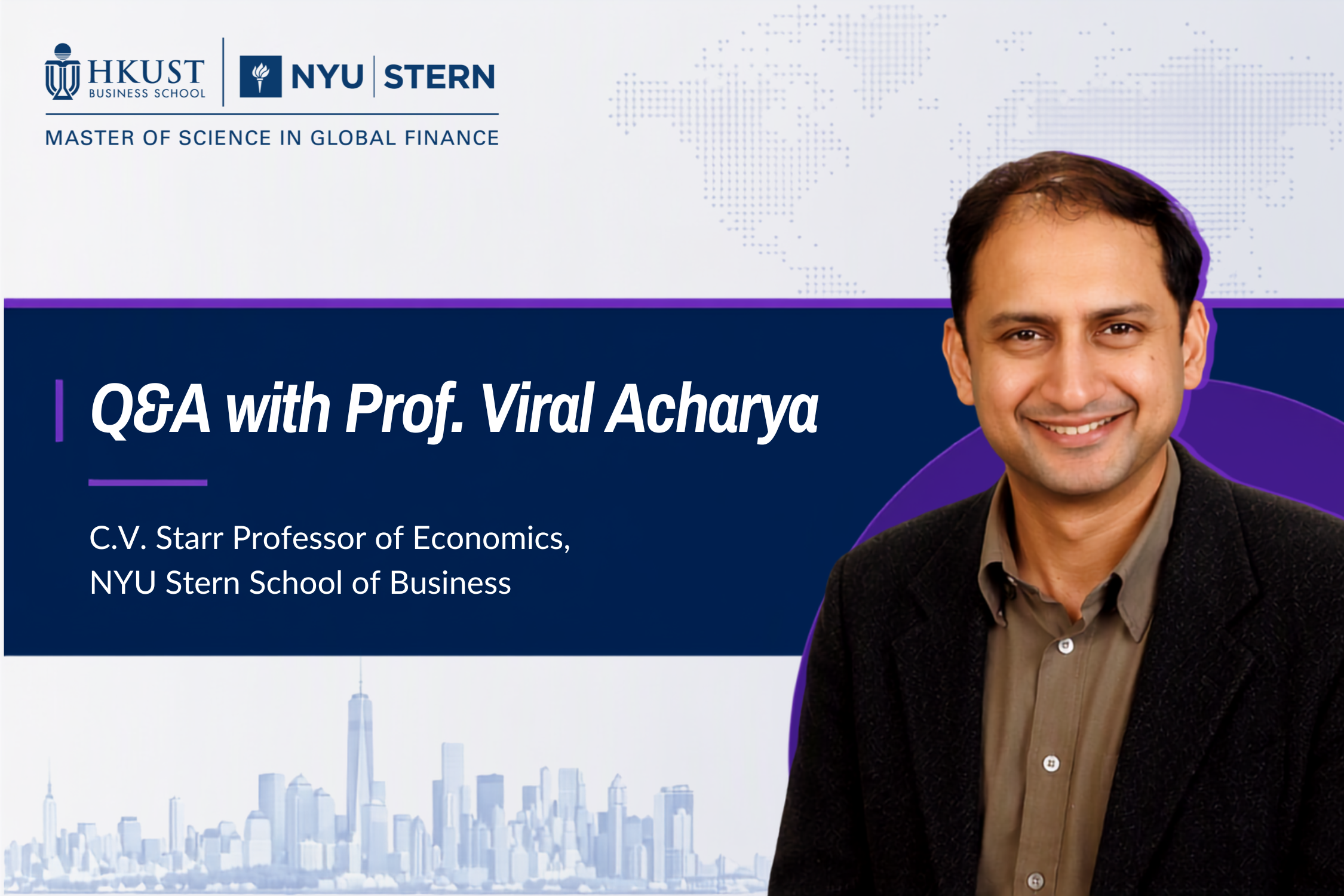
Risk Management in an Interconnected World: A Q&A with Professor Viral Acharya
Prof. Viral Acharya is C.V. Starr Professor of Economics at NYU Stern School of Business and former Deputy Governor of the Reserve Bank of India. His research and policy work focus on financial stability, systemic risk, banking, sovereign debt, and financial regulation. Prof. Acharya currently teaches Risk Management in Financial Institutions in the HKUST-NYU Stern Master of Science in Global Finance (MSGF) program.
As the HKUST-NYU Stern MSGF Class of 2026 prepares to return to New York for the upcoming Risk Management module, we spoke with Prof. Acharya about the key risks shaping today's financial landscape—from AI-driven investment concentration and rising sovereign debt to leverage, liquidity, and the evolving challenge of diversification. In this Q&A, he shares his perspective on how finance professionals can better understand and manage risk in an increasingly interconnected global financial system.
Q1. As former Deputy Governor of the Reserve Bank of India, do you think markets today are underpricing systemic risk? What should investors and risk managers be doing differently in this environment?
I tend to agree that correlated risk is underpriced in markets. The sources seem to be an increasing expectation that monetary and/or fiscal authorities will bail out markets come what may, as has been the case since the Global Financial Crisis of 2007-08 and that we have not had a significant recession or market correction since.
Investors and risk managers should look beyond and ask what the limits of these “put” options from authorities are and when things might break down, and be prepared for that. That might involve managing private liquidity better and also de-risking plus de-leveraging to an extent.
Q2. Based on your experience across policy and financial markets, where do you see the biggest vulnerabilities in global corporate and sovereign credit markets today?
It is in a correlated shock or systemic risk to the financial sector. Triggers for these are of course hazardous to guess accurately, but likely vulnerabilities stem both from:
-
The investment boom and stretched as well as concentrated valuations in the Artificial Intelligence (AI)-exposed sectors in the market; and
-
The threat of fiscal and financial corrections interacting due to the increasing imbalance in developed-country government borrowings and the build-up of leverage in the financial sector taking positions in government bonds (notably, hedge funds doing carry trades).
Q3. Your research has highlighted how risks can build up across the financial system — does diversification still work the way investors expect in today’s market environment?
Yes and no.
At some level, the market has become excessively concentrated in the large technology firms and AI-exposed sectors. At another level, diversification with bonds is also not working well due to stock-bond return correlations having moved to zero or positive territory, i.e., the specter is one of stagflation when high growth coincides with higher-for-longer rates.
There is no good way to diversify away from these two risks. The best bet might be to keep adequate liquidity buffers — “cash is king” when aggregate risk hits, be globally diversified, and ensure leverage is at manageable levels under stress.
Q4. From your perspective across policy and academia, how is AI changing the nature of risk in global financial systems?
AI is undoubtedly a transformative and disruptive technology that will have a huge impact on how we do things as individuals, households, corporations, societies, and governments. It will be all-pervasive.
The productivity gains are also massive because of innovation being sped up, hitherto infeasible inquiries being made possible, and cross-fertilization of ideas across sectors of the economy.
The implications for the global financial system are whether the growth potential can be harnessed in a robustly stable way, or whether there is a risk of frothy valuations, investor return-seeking, and leveraged financing of substantial investments, leading to a hard landing or even a sudden stop of some nature.
Climate change implications of the huge energy demands of AI investments are also worth considering for the long run, and perhaps there are opportunities there too, in addition to formidable challenges.
Q5. For those unfamiliar with your Risk Management module, could you please share what makes this course distinctive, and how it will change the way finance professionals think about and manage risk in global financial markets?
It will provide students with a 35,000-foot view of a world that is evolving at a rapid pace and help connect the dots in a way that the naked eye often fails to see.
Accidents, for the most part, happen from hazards one cannot see or fails to anticipate. The course will try to reduce that risk by offering students a holistic perspective on banks and non-banks in the financial sector, risks stemming from government bond markets, and a perspective on both recent history and ongoing stresses.
Welcome aboard for a safe ride! 😊