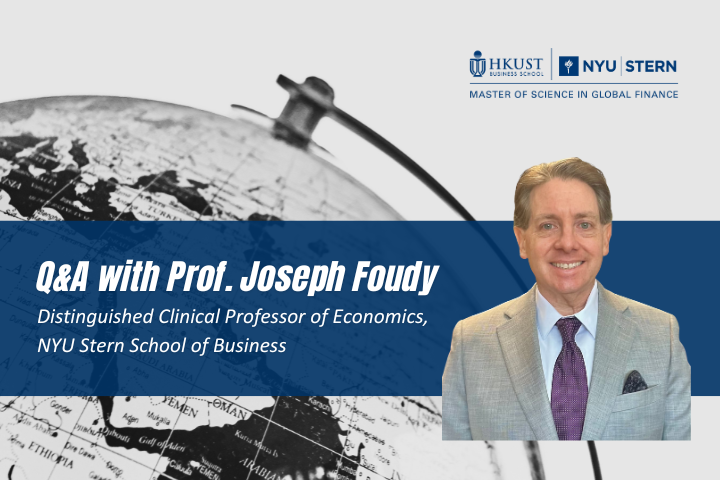
Professor Joseph Foudy is Distinguished Clinical Professor of Economics at NYU Stern School of Business. His research interests focus on the impact of globalization on national systems, the political economy of financial regulation and comparative corporate governance. He is interviewed regularly on business, economic and international issues and has appeared on CNN, Bloomberg, Fox, PBS and NPR as well as many international and New York City television outlets. He has also been quoted in the New York Times, the Wall Street Journal, the Washington Post and other international and domestic newspapers and magazines.
Prof. Foudy currently teaches Global Macro and Asian Markets in the HKUST-NYU Stern Master of Science in Global Finance (MSGF) program. In this Q&A, we discuss his teaching methods in the program, how students can fully benefit from his classes, and the importance of understanding global macro trends for finance professionals amid current world dynamics.
Q1. For those unfamiliar with your courses, could you share some insights about your teaching and research roles at NYU?
I joined Stern about 20 years ago and have taught their core global macroeconomics course ever since to every level of student from undergrads to MBAs and master's students to seasoned executives. When not teaching macro, I also teach classes on Emerging Markets and Asian Economies. I have led student trips to Asia for over 20 years going everywhere from Saigon to Seoul to Shanghai to Shenzhen. Currently I am leading two different undergraduate student trips each year to Singapore and Tokyo to visit local companies and study the business environment. I also do a course on global business trends where I get to debate trends and impacts of issues like AI, automation, demographics and immigration for the global economy (and our careers).
Q2. Your bio mentions your research interest in globalization and political economic topics. What about these topics captivates you?
My Ph.D. was actually in Political Science from Cornell, though always with a heavy emphasis on political economy. I was fascinated by how business varies by country and did a dissertation looking at German and Japanese capitalism, focusing on how corporate governance in each country shaped their auto industries. I got to live in both countries and interact with executives and it was an amazing experience for me.
I was recruited to Stern to help with this international focus. I combined teaching global macro and studying emerging markets with leading global study tours, especially to Asia. For me, I really found my calling and love combining insights about macroeconomics (inflation, unemployment and interest rates) with different countries’ growth stories and business practices. I’ve always had an especially strong focus on Asia, amazed by each country’s history and development experiences.
The HKUST-NYU Stern MS in Global Finance (MSGF) program has a unique mix of students. For instance, the Class of 2026 has an average of 14 years of work experience, with 50% at the director level or above, 80% in finance roles, and representing 18 countries and regions.
Q3. Given this unique student composition, how will the content and teaching methods of the course at MSGF differ from those in other programs?
My pedagogical approach for this course differs on two key dimensions from many of the classes I normally teach. First and most obviously, the course is condensed over three days where a typical MBA class might cover many of these materials over a semester. Second, we also have a deep bench of financial experience across the MSGF cohort. We have a class where everyone is already grappling daily with the broad range of macro trends and challenges that we will discuss in the course.
My teaching approach therefore tries to treat our time as an incredibly precious commodity. I will share a set of hopefully thoughtful materials. On the ground, I will aim for a mixed approach in the classroom, part lecture, part discussion and debate, perhaps sprinkled with a few interactive exercises as time allows. I have some short, hopefully well-chosen, videos to make us think as well. I’m a very visual teacher and at various points, I will simply put up on the board some interesting charts and data to share with the class to set the stage for our discussions.
Q4. What advice would you give to students attending your course to help them fully benefit from their learning experience?
First, come to class ready to share and interact, which I’m sure you already are adept at doing. Collectively, we have an amazing level of experience. But individually we all have knowledge gaps that could use filling (including me). Second, we will try to stay focused on long-term insight and analysis without overly focusing on immediate news. You’re already experienced and working in markets. What can we do to prepare you to see further down the road, especially as several challenges are going to hit us head-on in the coming years (AI, growing fiscal risks, demographic change, etc.) In short, we want to be strategic and not tactical thinkers. Third, many beliefs we would have taken for granted a year or two ago are now questioned (for example, the global role of the dollar). It’s easy to assume we live in a completely new world. That would be a mistake in the opposite direction. So, we must be skeptical about narratives that claim we are in totally unknown territory because sometimes less has changed than we assume.
In recent years, we’ve seen global dynamics shifting in ways very different from the past few decades. Some suggest that nationalism and reverse-globalization are on the rise.
Q5. In this context, how important do you believe it is for finance professionals to understand global macro trends?
The global macro environment has always been challenging. In our cohort, we have seen COVID and the aftershocks of the Global Financial Crisis. Looking back further than some of our immediate careers, we had the dotcom bubble and the Asian financial crisis. 60 years ago, Bob Dylan famously sang “The Times They Are A-Changin'” and it’s useful to remember crises are a recurrent and inevitable feature of finance.
Having said that, the macro uncertainties out there today, driven by economic and technological change and increased political risk, really do feel deeper and qualitatively different to me. In the course we will use the past as prologue and try to use both historical and current data to assess where we are today and how economies around the world are likely to evolve. Political risk is also interwoven into the fabric of global finance. Ian Bremmer, a noted political risk analyst, once noted that the definition of an emerging market is one where politics matters as much as economics to our investments. Going into 2026, this appears true in virtually every major economy.
Q6. What steps can finance professionals and corporate decision-makers take to better prepare for macroeconomic unpredictability?
It’s simple—almost trite—but also true that all of us have to remain intellectually curious and stay lifelong learners. How much time would the average finance professional 10–15 years ago have spent thinking about the debasement trade, stablecoins, DeFi or private credit? Or discussed whether the U.S. is in a “vibecession”? I have taught on the economics of tariffs for 20 years, but I’ve thought about them more in the past 8 months than my entire career. And we have only begun to understand how AI will transform the industry. Add to this other slow-moving but inexorable trends like aging and climate change.
Our classes are an important part of this journey, but we simply live in an ever-changing world. It is also one where the amount of information at our fingertips is greater than ever before, but we face information overload as well as questions about the quality and veracity of newer social media sources.