
THE HKUST-NYU STERN COLLABORATION
Q1. What benefits does the HKUST-NYU Stern collaboration bring to its participants?
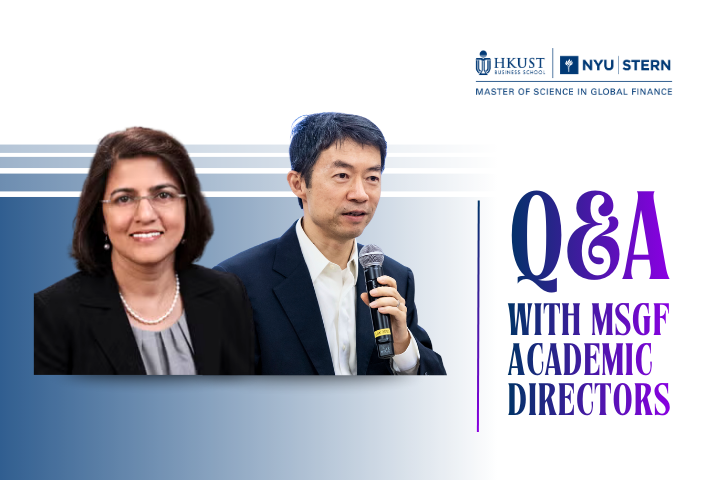
Prof. Jialin Yu: The HKUST-NYU Stern collaboration delivers a global finance program anchored in two of the world's leading financial centers. Participants gain dual perspectives on markets, regulatory frameworks, and investment practices--bridging Western and Asian approaches. This knowledge is increasingly critical as global capital flows become more complex and interconnected.
The program draws on faculty expertise from both institutions, uniting thought leaders who approach finance through diverse cultural and regulatory lenses. This enriches the curriculum with real-world examples and market-specific case studies, preparing graduates to operate effectively in an increasingly multipolar financial landscape.
MSGF VS EMBA/MBA
Q2. How does the MSGF program differ from Executive MBA or MBA programs with a finance stream? What advice would you give to prospective students deciding between the MSGF and Executive MBA or part-time MBA programs?
Jialin: The fundamental difference is depth versus breadth. An Executive MBA or MBA provides a broad, cross-functional business education—strategy, marketing, operations, leadership—with finance as one of many components. The MSGF offers deep, specialized expertise in finance, tailored for professionals seeking to progress in finance or finance-adjacent roles.
Consider your career trajectory. If you're a finance professional aiming for senior roles in investment, risk management, or corporate finance, or if you're transitioning into finance from related fields like accounting, consulting, or technology, the MSGF's specialized curriculum will be more directly relevant. It delves far deeper into portfolio theory, derivatives, fixed income, and market structure than a generalist MBA can. By contrast, if your ambitions lie in general management or entrepreneurship, an MBA or Executive MBA might be the better fit.
Also consider networking. MBA programs connect you with professionals across industries and functions, while the MSGF program offers a concentrated finance network, which is especially valuable for accelerating a career within the finance sector.
MSGF VS OTHER MFIN PROGRAMS
Q3. What makes the MSGF program unique compared to other finance master's programs in terms of academic offerings?
Jialin: The MSGF program distinguishes itself through three key dimensions. First, it's designed for experienced professionals rather than recent graduates. The curriculum assumes substantial prior work experience and emphasizes strategic decision-making over entry-level technical skills.
Second, its modular, block-based structure is tailored to fit the schedules of working professionals. By concentrating coursework into intensive blocks, participants can continue their careers while applying course concepts to real, ongoing workplace challenges.
Third, the program prepares participants for senior roles where financial decisions intersect with strategy, risk management, and cross-border issues. The curriculum balances quantitative methods and valuation techniques with study of market structure, regulatory frameworks, and the evolving global financial landscape.
THE EXPERIENCED COHORT
Q4. A typical MSGF cohort has about 80% of students coming from the finance sector and finance functions, representing over 10 countries and regions, with an average of more than 10 years of work experience. How does this cohort composition influence the learning experience for participants?
Jialin: This composition transforms the classroom into a forum for exchanging practical, cross-disciplinary finance insights. When discussing portfolio construction, you learn alongside asset managers who implement these strategies day to day. When exploring corporate finance, you engage with investment bankers and corporate treasurers who navigate these decisions in their professional lives.
The substantial work experience of participants elevates classroom discussions beyond theory. Participants bring real-world case studies from their careers, test assumptions against market realities, and identify practical implementation challenges that theory can miss. This peer learning often proves as valuable as the formal curriculum.
Geographic diversity further enriches the learning environment. Financial markets are global, yet market structures, regulatory environments, and investor behaviors vary significantly across regions. Having classmates who understand Asian capital markets, Middle Eastern sovereign wealth funds, European banking regulations, and emerging market dynamics enriches discussions with real-world complexities that textbooks can't capture.
FOR DIFFERENT CAREER STAGES
Q5. How do the mid-senior level executives and younger professionals (with around 5 years of experience) each uniquely benefit from the MSGF experience?
Jialin: For mid-senior executives with 10-15+ years of experience, the MSGF program provides the theoretical frameworks and analytical rigor that formalize intuitions developed on the job. Many senior professionals have sophisticated market instincts but lack the structured finance language and methods to articulate those insights for strategic decision-making. The program helps them systematize their tactic knowledge, update their quantitative toolkit, and earn a credential that strengthens credibility at senior levels.
The program also gives experienced leaders the rare space to step back from day-to-day pressures to think strategically about market structure, emerging trends, and the future of finance—an opportunity for reflection that demanding roles seldom provide.
For younger professionals with roughly five years’ experience, the MSGF presents a different but equally meaningful value. They gain direct exposure to senior practitioners’ decision frameworks and career trajectories, while acquiring technical skills and strategic perspectives earlier than they might through on-the-job learning alone, accelerating their professional development.
Importantly, both groups benefit from their interactions. Younger professionals receive mentorship and expanded networks, while seasoned executives encounter fresh perspectives and innovative approaches. This multi-generational learning environment mirrors real-world finance teams and equips all participants for collaborative, leadership roles.
THE MODULAR FORMAT
Q6. The MSGF program is structured in six intensive modules over one year, each lasting about a week. What are the benefits of this modular format compared to the weekly or bi-weekly classes offered by other part-time programs?
Prof. Manjiree Jog: The MSGF program is designed for working professionals. The modular structure allows participants to earn a master's degree that helps advance their careers without requiring them to leave full-time employment. This intensive modular structure allows students from around the world to participate in the program, as it would be impractical for them to travel weekly or bi-weekly for a part-time program with regular classes.
THE LEARNING LOCATIONS
Q7. The MSGF program involves multiple learning locations, including Hong Kong, New York, and a rotating global location. What advantages does this arrangement offer to participants?
Manjiree: The MSGF program’s multiple learning locations provides students with an immersive learning experience in leading global financial centers, each characterized by distinct financial markets as well as unique social, economic, and political contexts. Through this experience, students can gain a deeper knowledge of the nuanced differences among markets, a keen understanding of today’s interconnected economies, and build international networks. Combined with the geographic diversity of the MSGF students, this design makes MSGF a truly global program.
Q8. Why was Abu Dhabi chosen as the rotating global location for 2026?
Manjiree: The 2025-26 cohort will take their Module 2 classes on the beautiful NYU Abu Dhabi campus, fully leveraging NYU’s global reach. During this module, they will engage with thought leaders and professional practitioners based in Abu Dhabi.
The United Arab Emirates (UAE) is rapidly emerging as a leader in technology and innovation, driven by several key advantages. Its low energy cost and abundant energy resources make it an ideal location for AI data centers. Its strategic geographical location allows for easier access to markets in Europe, Asia and Africa. The UAE government is making substantial investments in innovation, education, and infrastructure, fostering the development of start-up ecosystems such as Hub71 in Abi Dhabi. This commitment to growth positions the UAE as a prime hub to explore cutting-edge developments and investment opportunities in the region.
THE IN-PERSON LEARNING
Q9. Why is it important for participants to attend the modules in person?
Manjiree: In an advanced degree program, students learn from faculty and from each other. Meeting in person is essential for forming meaningful connections with peers and faculty. This community yields benefits that extend well beyond graduation. Additionally, in-person classes encourage active participation and provide immediate feedback. This feedback helps faculty to fine tune the material to the needs of the class, while helping students improve their understanding.
THE CURRICULUM
Q10. The curriculum progresses from foundational courses to advanced topics. What is the reasoning behind this design?
Jialin: This progression ensures all participants, regardless of their finance backgrounds, acquire a common analytical foundation before moving to advanced applications. Finance professionals arrive with varied backgrounds: buy-side asset management, sell-side banking, corporate finance, regulation, and more. They often bring deep, domain-specific expertise but limited exposure to other areas.
The foundational courses build shared frameworks for thinking about valuation, risk, and market efficiency, creating the common language required for integrated, advanced topics. For instance, an understanding of complex derivatives requires solid foundations in both pricing theory and market environment; corporate restructuring draws on knowledge of valuation, capital structure, derivatives, and strategic analysis.
The structure also acknowledges that experienced practitioners benefit from revisiting fundamentals with the analytical rigor of an academic setting. Practical insights and undergraduate studies can be formalized and strengthened, reducing small but consequential gaps that can lead to misjudgments in large transactions or high-stakes decisions.
Finally, this sequence mirrors how financial reasoning develops in practice—starting with individual instruments and concepts and progressing to their integration into comprehensive strategies and organizational decisions. By the capstone, participants will have both the technical tools and conceptual frameworks to address complex, multifaceted financial challenges.
THE EVOLVING COURSES
Q11. Given the rapid changes in our world, both inside and outside the finance sector, how have the MSGF courses adapted content to address current challenges?
Jialin: The curriculum is continually updated to reflect new developments in financial markets and the global economy. In recent years this has included integrating sustainable finance and ESG—not only as standalone topics but embedded within asset pricing, risk management, and corporate finance—reflecting their increasing influence on investment decisions, valuations, and regulations.
The program has also broadened coverage of fintech and digital assets, examining how technology is reshaping financial intermediation. While maintaining rigorous foundations in financial theory, courses now address the impact of blockchain, artificial intelligence, and alternative data on trading, lending, and asset management.
Finally, the curriculum keeps pace with evolving macroeconomic and central banking challenges: inflation dynamics, unconventional monetary tools, the interplay between fiscal stimulus and markets, and the growing role of geo-economics in corporate decision-making. These aren't abstract concepts but fundamental drivers of asset prices and corporate strategy.
THE INTEGRATIVE PROJECT
Q12. What is the objective of the Integrative Project in the MSGF program?
Jialin: The Integrative Project culminates the MSGF experience, requiring participants to synthesize concepts, methods, and frameworks from across the curriculum to tackle a significant financial challenge. Students integrate valuation techniques, risk analysis, market assessment and strategic thinking in a way that mirrors real-world decision-making.
The project develops skills that are hard to teach in isolation: framing complex problems, identifying appropriate analytical approaches, making decisions under uncertainty, and communicating recommendations persuasively. These abilities distinguish senior financial professionals from colleagues who may excel at narrow technical tasks but lack broader strategic practice. Most capstone projects are team-based, reflecting how major financial decisions are made in organizations. Participants learn to leverage diverse expertise, reconcile differing viewpoints and reach consensus on comprehensive strategies.
Finally, many projects address actual challenges faced by participants’ organizations or industries, such as evaluating investments, testing new business models, or analyzing market entry strategies, creating immediate professional value beyond academic credit.